
Fremont County Arrest Records and Charges
Fremont County arrest records may appear through the Fremont County Sheriff's CRIMEWATCH public feed, arrest and jail intake content, incident-related pages, and custody channels. The sheriff's public site is administered by law enforcement and includes arrests, warrants, most wanted entries, detention links, bonding information, and inmate locator routes. Those records can show an arrest event, arresting agency language, alleged charge text, warrant wording, date, and sometimes bond or release language.
Court charges after arrest are different. The 11th Judicial District Attorney reviews the incident and files formal charges when prosecution moves forward. The filed complaint, information, or indictment becomes part of the court record at Fremont Combined Court. The full court case, plea, disposition, and sentence belong in the Fremont County criminal court records file. Custody and current jail status belong with Fremont County inmate records.
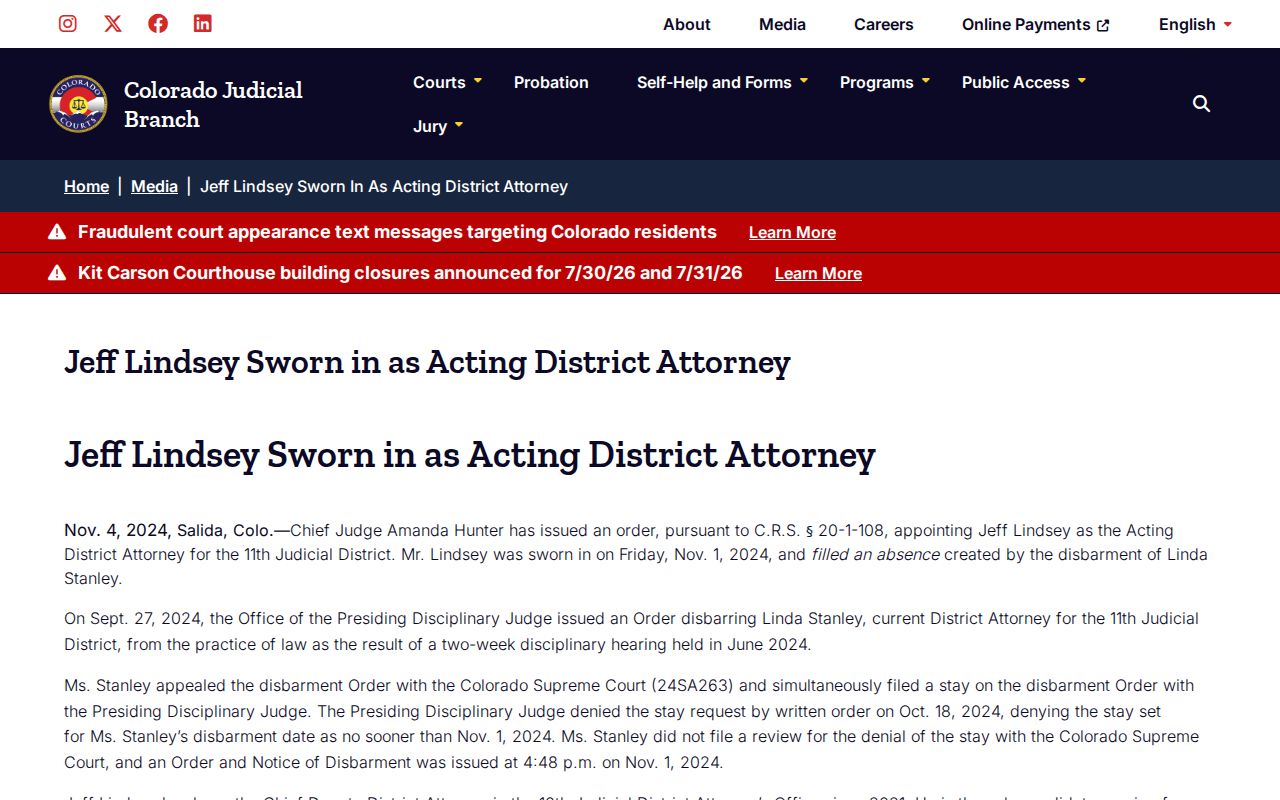
The Colorado Judicial Branch press release on Jeff Lindsey gives local context for the district attorney role in the 11th Judicial District.
The prosecutor's filing decision is the key bridge between an arrest listing and the court charge record.
Search Fremont Arrest Records and Charges
Start with the record type. For public arrest or jail intake information, use the Fremont County Sheriff's CRIMEWATCH page and its arrest, warrant, and detention links. For court charges after arrest, use Colorado Judicial Branch docket search for hearing information and the record/document request form for copies of filed charges, orders, dispositions, and sentencing records. If the matter is municipal, use Cañon City Municipal Court or Florence Municipal Court rather than the state court route.
- Check the sheriff's CRIMEWATCH arrest or warrant feed for public law-enforcement postings.
- Use the Colorado docket search for hearing dates tied to the court charge record.
- Request court documents through the Judicial Branch form when a complaint, information, order, or disposition is needed.
- Read each count separately because charges may be amended, reduced, dismissed, or resolved in different ways.
- Call the correct office when the record may be municipal, restricted, suppressed, or still under active investigation.
Fremont County arrest records also intersect with jail and notification systems. The sheriff's inmate locator route points current-custody searches to VINELink Colorado or Intake/Booking by phone. VINELink is useful for custody notifications, but it is not the final court record and does not replace the case file. CoCourts or State Courts Data Access may help with public case data, while the court document request form remains the copy route.
The VINELink Colorado route is assigned in the Fremont research as a custody and notification channel.

VINELink can help confirm custody status, while the court record explains filed charges and case movement.
Charging Documents After Arrest
An arrest does not always match the final charge list. Law enforcement may list alleged offenses or warrant language at booking, then the district attorney reviews reports, witness information, evidence, criminal history, and legal elements. The formal court charge record begins with a charging document. In Fremont County, state misdemeanor and felony charges route through the 11th Judicial District court system, with County Court and District Court roles based on the case level.
| Complaint | Information | Indictment | |
|---|---|---|---|
| Filed by | Often used to begin a criminal case with alleged facts and counts. | Filed by the prosecutor as a formal statement of charges. | Returned through a grand jury process when used. |
| Common use | Misdemeanor, initial felony complaint, or early court filing. | Formal felony prosecution or amended charge filing. | Serious or complex prosecution when grand jury review applies. |
| Record impact | Creates the first court charge list. | May replace or refine earlier counts. | Sets out charged counts after indictment. |
Note: The Fremont research did not identify a local public charge-code database, so charge text should be verified from the court filing.
Charge Status and What It Means
Charge status changes as court charges after arrest move through review, negotiation, hearings, and disposition. One arrest can produce several counts. Some counts may remain pending while others are dismissed, reduced, amended, or resolved by plea. A charge table should be read count by count, then checked against the final disposition and sentence. A sheriff arrest feed entry is only the beginning of that timeline.
| Status | What It Means |
|---|---|
| Pending | The count has not reached a final outcome and may still be set for hearing, plea, or trial. |
| Amended or reduced | The filed count changed, often by prosecutor filing, plea negotiation, or court action. |
| Dismissed with prejudice | The count ended and cannot be refiled in the same way. |
| Dismissed without prejudice | The count ended, but may be refiled if law and timing allow. |
| Disposed | The count has a final recorded outcome such as guilty plea, acquittal, conviction, or dismissal. |
Charges vs. Convictions
Fremont County arrest records and court charge records often list accusations before any final finding. A conviction appears only after a guilty plea, guilty verdict, or other qualifying judgment. Public arrest and warrant feeds may use direct charge language, but the final court file can show that a charge was dropped, dismissed, amended, reduced, or resolved on a different count. Always read the disposition before treating a charge as an outcome.
| Charge | Conviction | |
|---|---|---|
| Timing | Filed after arrest, summons, warrant, or prosecutor review. | Recorded when the court reaches a guilt-based outcome. |
| Meaning | An allegation that must still be proved or resolved. | A final outcome that may carry sentence terms. |
| Where to verify | Charging document and current docket entries. | Disposition, sentencing order, and register of actions. |
Sealed vs. Expunged Records
Colorado sealing rules can restrict public access to some criminal records, but sealing does not erase the record or vacate a conviction. Judicial Branch guidance says sealed criminal records may remain available to the court, probation, criminal justice agencies, and the district attorney. Expungement is distinct and should not be promised for adult arrest or charge records unless the specific statute and court order support it. Juvenile matters follow separate access rules.
| Sealed | Expunged | |
|---|---|---|
| Public visibility | Restricted from ordinary public search after a qualifying order or process. | Handled under a separate statute, often with narrower categories. |
| Record existence | Record remains available for certain justice-system uses. | Effect depends on the expungement law and case type. |
| Charge impact | Does not mean the charge never existed. | Requires case-specific legal authority. |
Charge Codes and Severity Levels
Charge records may identify separate counts, offense text, and severity level. In Fremont County, felony matters move through District Court after filing or bindover. Misdemeanors and many preliminary criminal matters are County Court matters. Municipal charges can remain with Cañon City Municipal Court or Florence Municipal Court if the citation or allegation is based on city ordinance. One arrest can produce several counts, and each count can move in a different direction.
Common court terms include complaint, information, count, plea, disposition, dismissed with prejudice, dismissed without prejudice, deferred sentence, probation, restitution, and warrant. A disposition is the final outcome. A deferred sentence is an outcome where judgment or sentence consequences may change after compliance. Restitution is money ordered to compensate victim loss.
Statewide Charge and Criminal History Lookups
Statewide court data routes include CoCourts and Colorado State Courts Data Access, while official copies are requested through the Colorado Judicial Branch record/document request form. Criminal justice agency records are governed by the Colorado Criminal Justice Records Act. Sheriff arrest postings are agency records, not the court's final charge history. If a record is needed for a legal filing, licensing issue, or formal review, request the court document or certified copy through the court rather than relying only on a public feed.
Access rule: Court charge records, sheriff arrest records, and county administrative records can have different custodians and different access limits.
Background Check Considerations
Arrest and charge data can be stale or incomplete if read without the final disposition. The sheriff's CRIMEWATCH site warns that accused persons are presumed innocent until proven guilty beyond a reasonable doubt and that public content may change. A regulated background report must follow the Fair Credit Reporting Act and other applicable law. Public court and sheriff lookups are best used to identify the official record holder, case number, charge status, and next verification step.
Important: Verify Fremont County arrest and charge results with the sheriff, court, or issuing agency before high-stakes use.
Restricted Fremont Charge Records
Some Fremont County arrest records and court charge records are limited by law, court order, or agency policy. Juvenile cases are restricted under the Children's Code and CJD 05-01. Suppressed court cases may require government photo ID. Records with protected addresses, financial account numbers, Social Security numbers, medical information, minor names, or victim-safety information may be redacted. Search warrants and investigative records may be sealed or withheld while an investigation is pending.
The best access path depends on who holds the record. Use the sheriff for arrest, booking, warrant, and criminal justice agency records. Use Fremont Combined Court for filed charges, pleadings, orders, dispositions, and sentencing documents. Use municipal court for city ordinance charges. Note: When an arrest feed and court case conflict, the court disposition controls the court-charge outcome.